
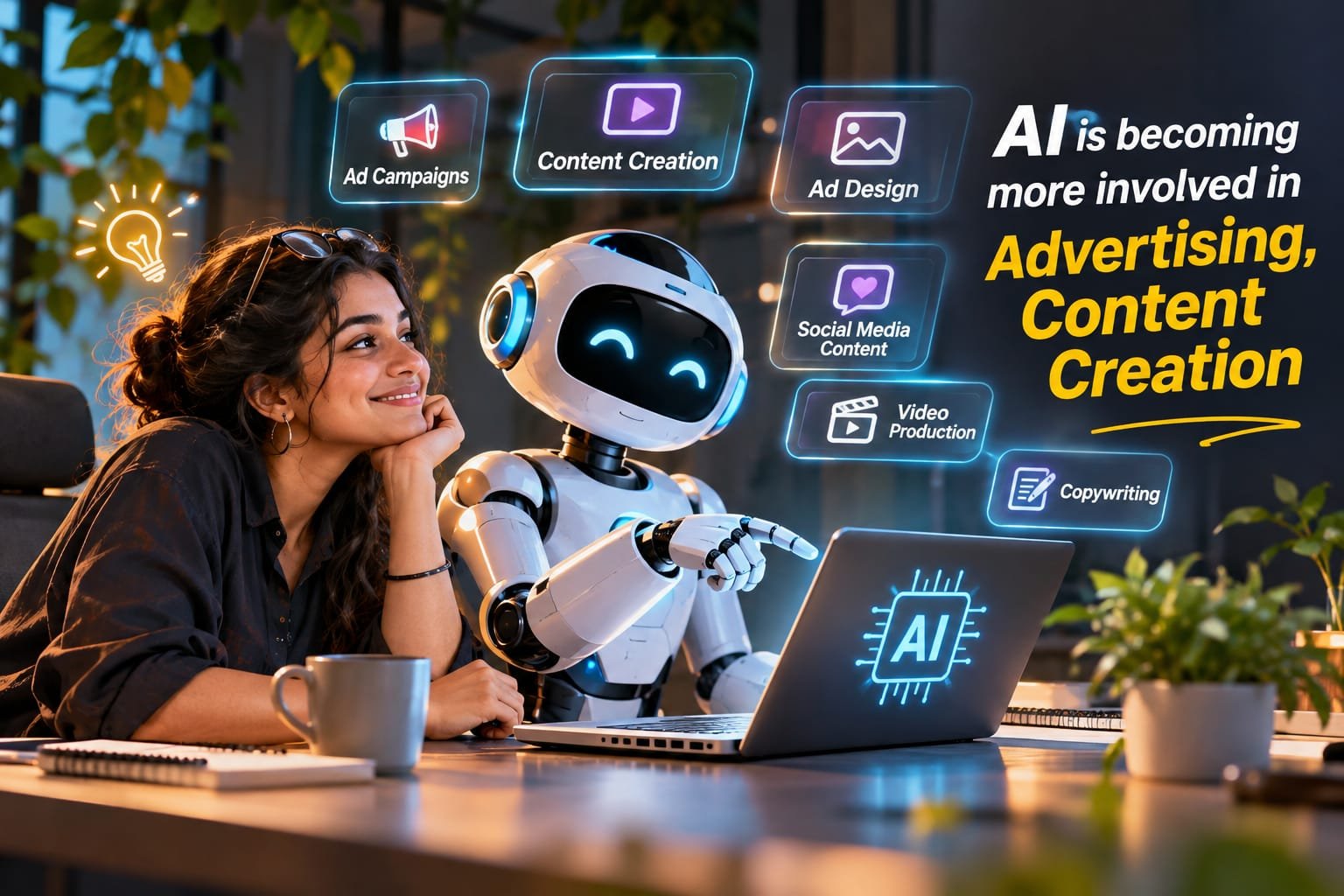
Artificial Intelligence (AI) has become a part of our everyday lives. From getting answers through AI chatbots to seeing personalised advertisements while browsing online, we can notice how much technology has changed the way we use the internet.
Digital marketing is one of the industries experiencing this change. Businesses are now using AI tools to create content, manage advertisements, understand customer interests and improve their online presence.
A few years ago, marketers had to spend hours researching keywords, designing posts and analysing campaign results. Today, AI can help with many of these tasks in less time.
But AI is not just about making work easier. It is also changing how brands communicate with people and build customer relationships.
Let’s understand how AI is transforming advertising, content creation and customer experiences.
1. AI in Advertising: Smarter Ways to Reach Customers
Have you ever searched for a product online and noticed advertisements for similar products appearing on different websites? This is one example of how data and advertising technology can help businesses reach relevant audiences.
AI is making online advertising more efficient by helping marketers understand audience behaviour and improve their campaigns.
Platforms like Google Ads and Meta Ads use AI-powered features to support targeting, bidding and campaign optimisation.
Here are some ways AI is helping advertisers:
- Finding the right audience: AI analyses available audience signals to help businesses reach potential customers.
- Automated bidding: It helps advertising platforms adjust bids according to campaign objectives.
- Better ad performance: Marketers can use AI-powered insights to understand which advertisements are working well.
- Personalised advertisements: Businesses can create relevant messages for different customer groups.
- Campaign optimisation: AI helps automate certain advertising decisions and improve campaign efficiency.
For example, imagine a small business selling skincare products online. Instead of manually adjusting every advertising setting, the business can use AI-powered Google Ads features to help optimise its campaign towards potential customers.
This saves time and allows marketers to focus more on creative ideas, budgets and overall strategy.
2. AI in Content Creation: Making Content Work Easier
One of the biggest challenges for digital marketers is coming up with fresh content regularly.
Whether it is writing blogs, preparing Instagram captions, designing posters or creating video scripts, maintaining a consistent content schedule takes time and effort.
AI tools are making this process easier.
Today, content creators use AI to find new ideas, prepare content drafts, create visuals and organise their marketing activities.
Some common examples include:
- Blog writing: Finding new topics, preparing outlines and improving written content.
- Social media marketing: Creating captions, post ideas and monthly content calendars.
- Graphic designing: Generating creative image ideas and marketing visuals.
- Video content: Preparing scripts, captions and ideas for Instagram Reels and YouTube Shorts.
- SEO activities: Finding keyword suggestions and improving website content.
For example, if a digital marketer wants to create an Instagram campaign for a new product, AI can help generate post ideas, suggest captions and prepare a basic content calendar.
Tools such as ChatGPT and Canva AI can support these activities and reduce the time spent on repetitive work.
However, simply copying AI-generated content is not a good content strategy. Every piece of content needs a personal touch. Adding real examples, creative ideas and a brand’s unique voice makes it more interesting for readers.
3. AI in Customer Experiences: Understanding People Better
Good customer service is important for every business. People expect quick answers when they have questions about a product or service.
But what happens when a business receives hundreds of enquiries every day?
This is where AI can help.
AI-powered chatbots and virtual assistants allow businesses to respond to common questions without requiring a person to answer every enquiry manually.
Some everyday examples of AI in customer experience include:
- Chatbots: Answering common questions and providing instant assistance.
- Product recommendations: Suggesting products based on customer interests and browsing activity.
- Personalised messages: Helping businesses communicate with customers using relevant information.
- Customer support: Handling repetitive enquiries and directing customers to useful resources.
- Understanding customer behaviour: Analysing patterns to help businesses understand what customers are looking for.
For example, when you visit an online shopping website, you may see product recommendations based on your previous searches or purchases.
This makes shopping more convenient and helps customers find products that match their interests.
For businesses, these small improvements can make a big difference in customer satisfaction.
4. Why Are Businesses Using AI in Digital Marketing?
AI is no longer limited to large companies. Small businesses, startups, freelancers and marketing agencies are also exploring AI tools to improve their work.
Here are some reasons why businesses are adopting AI:
1. Less time on repetitive tasks
AI can help with content ideas, basic research, data analysis and other routine activities.
2. Improved productivity
Marketers can manage different activities more efficiently and spend more time planning campaigns.
3. Better understanding of customers
AI-powered tools help businesses identify customer interests and behaviour patterns.
4. More creative possibilities
AI provides fresh ideas for advertisements, social media posts, blogs and marketing campaigns.
5. Data-based decisions
Instead of depending only on assumptions, marketers can use available data and AI-powered insights to improve their strategies.
Of course, AI does not guarantee better marketing results. The outcome still depends on how well businesses use these tools.
5. Challenges of Using AI in Digital Marketing
Although AI makes many marketing activities easier, it also comes with a few challenges.
Using AI without proper knowledge or checking can sometimes create more problems than benefits.
Some important things businesses should consider are:
- Accuracy: AI can sometimes provide incorrect information, so content needs fact-checking.
- Originality: Publishing too much automatically generated content can make a brand sound repetitive.
- Data privacy: Businesses must handle customer information carefully and responsibly.
- Human creativity: AI-generated content may not always understand emotions, culture or the exact message a brand wants to communicate.
- Overdependence: Marketers should not depend entirely on AI for important decisions.
The best way to use AI is to combine its speed with human creativity and experience.
6. What Is the Future of AI in Digital Marketing?
The role of AI in digital marketing is growing, and businesses are finding new ways to use it every day.
In the coming years, we may see more personalised advertisements, smarter marketing automation, advanced content creation tools and improved customer support systems.
For digital marketers, understanding AI tools will become an important part of developing their skills.
However, one question many people ask is: Will AI replace digital marketers?
The answer is not that simple. AI can assist with writing, designing, analysing data and managing certain marketing tasks. But understanding customer emotions, building trust, developing creative campaigns and making strategic decisions still require human involvement.
Instead of seeing AI as a competitor, marketers should learn how to work alongside it.
Conclusion
AI is changing the way businesses approach digital marketing. It is helping advertisers reach relevant audiences, making content creation easier and allowing businesses to offer better customer experiences.
For small businesses, it provides opportunities to compete more effectively. For digital marketers, it opens the door to new tools, skills and creative possibilities.
But technology alone cannot build a successful brand. Businesses still need good ideas, meaningful communication and a clear understanding of their customers.
The real advantage comes from knowing when and how to use AI.
AI can make marketing faster and smarter, but it’s human creativity that gives every brand its unique identity.