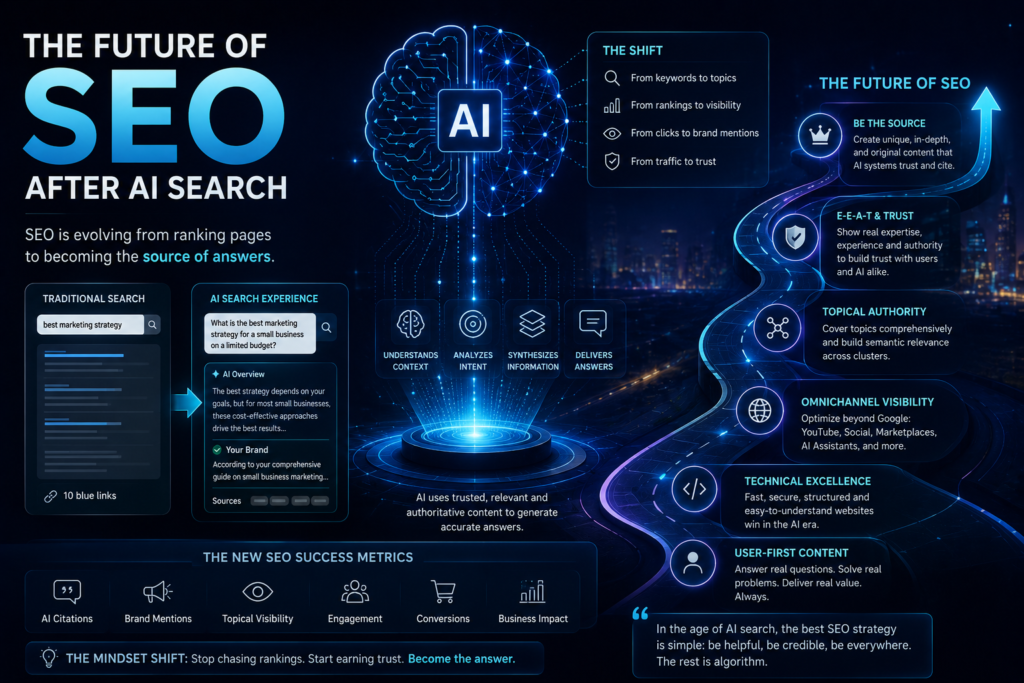
Search engine optimization (SEO) has always evolved alongside the way people search for information. From keyword stuffing and link building to mobile optimization, semantic search, and helpful content, businesses have continuously adapted to changes in search technology. Today, SEO is entering another major transformation: the rise of AI-powered search.
Tools such as Google’s AI search experiences, ChatGPT, Microsoft Copilot, and other generative AI platforms are changing how users discover information. Instead of simply displaying a list of links, AI can understand questions, summarize information, compare options, and provide direct answers.
This raises an important question for marketers and website owners: What does the future of SEO look like after AI search?
The answer is not that SEO is disappearing. Instead, SEO is becoming broader, more sophisticated, and increasingly focused on authority, relevance, trust, and visibility across multiple search environments.
The Shift From Traditional Search to AI Search
Traditional search engines generally work by matching a user’s query with relevant web pages and presenting results in a ranked list. Users then click on those results to find the information they need.
AI search changes this experience. A user can ask a conversational question and receive a synthesized answer based on information gathered from multiple sources.
For example, instead of searching for “best digital marketing strategies,” a user might ask:
“What digital marketing strategy should a small business use to increase leads with a limited budget?”
An AI-powered search system can interpret the context, identify relevant strategies, compare them, and provide a personalized response.
This means businesses can no longer focus exclusively on ranking for individual keywords. They must also consider whether their content is useful enough to be understood, trusted, and potentially referenced by AI systems.
SEO Will Become More About Visibility Than Rankings
For years, one of the primary goals of SEO has been achieving a position on the first page of Google. While rankings remain important, AI search introduces a new concept: being visible within an AI-generated answer.
A business may receive fewer traditional clicks but still benefit if its brand, products, research, or expertise are mentioned in an AI response.
This creates a broader definition of search visibility.
Future SEO strategies will likely measure:
- Traditional search rankings
- Organic traffic
- Brand mentions
- AI-generated search citations
- Visibility across multiple search platforms
- Conversion rates
- Branded searches
- Engagement and customer actions
The goal will shift from simply “ranking #1” to becoming one of the most trusted sources for a particular topic.
Content Quality Will Matter More Than Keyword Density
AI makes it easier than ever to produce large amounts of content. As a result, publishing hundreds of generic AI-generated articles is unlikely to provide a sustainable competitive advantage.
Search engines and AI systems need reliable information, not simply more information.
The future of SEO will therefore reward content that demonstrates genuine expertise and provides something valuable to readers.
High-quality content should:
- Answer the user’s actual question
- Provide original insights
- Include accurate and useful information
- Demonstrate experience or expertise
- Use credible sources where appropriate
- Be easy to understand
- Provide examples, data, or practical recommendations
- Be regularly updated
Instead of asking, “How many keywords should this article contain?” marketers should ask, “What can this article provide that competing content cannot?”
That mindset will become increasingly important.
E-E-A-T Will Become Even More Important
Experience, Expertise, Authoritativeness, and Trustworthiness—often summarized as E-E-A-T—are increasingly important concepts in modern SEO.
AI search makes trust even more significant because users may rely on an AI-generated answer without visiting every source behind it.
Businesses should therefore make their expertise visible.
For example, a financial website can strengthen credibility by publishing content created or reviewed by qualified professionals. A technology company can demonstrate expertise through original research, case studies, product testing, and detailed technical guides.
Author information, company information, references, customer experiences, original data, and transparent editorial practices can all contribute to stronger trust signals.
In the future, who created the content and why users should trust them may matter almost as much as the content itself.
Original Research Will Become a Competitive Advantage
Generic information is easy for AI to reproduce. Original information is much harder to replace.
This makes original research one of the most powerful future SEO strategies.
Businesses can create unique content through:
- Industry surveys
- Customer research
- Original statistics
- Case studies
- Experiments
- Expert interviews
- Product comparisons
- Proprietary datasets
- Real-world testing
For example, an SEO agency could publish an annual report analyzing thousands of search queries. Other websites may reference that research, increasing backlinks, brand awareness, and the likelihood of being recognized as an authoritative source.
The future belongs to organizations that create information, not just summarize it.
SEO Will Expand Beyond Google
Another major change is that search is no longer limited to traditional search engines.
People increasingly discover information through YouTube, Reddit, social media platforms, marketplaces, AI assistants, and specialized websites.
This means businesses need a broader search strategy.
A company might optimize:
- Its website for Google
- Videos for YouTube
- Social content for platform search
- Product listings for marketplaces
- Discussions and resources for community platforms
- Structured information for AI systems
This approach can be called search everywhere optimization.
Rather than asking, “How do we rank on Google?” marketers will increasingly ask, “Where does our target audience search, and how can we become visible there?”
Technical SEO Will Still Matter
The rise of AI does not eliminate technical SEO.
Search engines and AI systems still need to discover, crawl, interpret, and understand websites.
Important technical factors will continue to include:
- Website speed
- Mobile usability
- Crawlability
- Internal linking
- Structured data
- Clear site architecture
- Indexability
- Secure browsing
- Accessible content
Well-structured websites make it easier for search technologies to understand what a business offers and which information is most important.
Technical SEO may become less visible to marketers, but it will remain an essential foundation.
The Role of Keywords Will Change
Keywords will not disappear, but their role will evolve.
AI-powered search understands context, intent, relationships between concepts, and conversational language. Therefore, businesses should focus less on repeating exact-match phrases and more on covering topics comprehensively.
For example, an article targeting “email marketing” might naturally address related questions such as:
- What is email marketing?
- How does email marketing work?
- What are the benefits?
- How much does it cost?
- Which tools should businesses use?
- How can campaigns be measured?
This creates topical depth rather than keyword repetition.
The future of keyword research will be about understanding what people want to accomplish, not simply identifying the words they type.
Human Creativity Will Become More Valuable
Ironically, as AI becomes more powerful, human creativity may become more valuable.
AI can generate summaries, outlines, and drafts quickly. But unique opinions, experiences, storytelling, strategic thinking, and original ideas remain powerful differentiators.
Successful SEO teams will likely use AI as a productivity tool while maintaining strong human oversight.
The winning formula will not be “AI versus humans.” It will be AI plus human expertise.
Conclusion
The future of SEO after AI search is not the end of SEO. It is the evolution of SEO into a broader discipline focused on visibility, authority, trust, and user experience.
Businesses that rely solely on traditional keyword rankings may struggle as search behavior changes. Those that invest in genuinely useful content, original research, technical excellence, expert knowledge, and visibility across multiple platforms will be better positioned for the future.
The most important lesson is simple: don’t create content just to rank. Create content worth discovering, trusting, and referencing.
As AI changes the way people search, the businesses that provide the most reliable and valuable information will have the strongest opportunity to remain visible—whether the user discovers them through a traditional search result, an AI-generated answer, a video, a social platform, or the next generation of search technology.